Launch · 2026-05-28 · 8 min read
Claude Opus 4.8 Lands: The Benchmark Sweep, the $5/$25 Pricing, and What It Means for Your Bill
Anthropic shipped Claude Opus 4.8 on May 28, 2026 — a new frontier flagship that sweeps agentic coding, multidisciplinary reasoning, computer use, and finance benchmarks against Opus 4.7, GPT-5.5, and Gemini 3.1 Pro. Same $5/$25 per million-token pricing as Opus 4.7, but materially better numbers. Here's what changed, where it actually wins, and how to slot it into your stack without blowing the budget.
TL;DR
- Released: May 28, 2026.
- Pricing: $5.00 / 1M input • $25.00 / 1M output — identical to Opus 4.7. Prompt caching (90% off cached input) and Batch API (50% off both directions) both supported.
- Context window: 1,000,000 tokens (same as Opus 4.7, still the largest among closed-source flagships).
- Wins: SWE-Bench Pro, OSWorld-Verified, Humanity's Last Exam (with and without tools), GDPval-AA knowledge work, Finance Agent v2.
- Loses: Terminal-Bench 2.1 — GPT-5.5 (78.2%) still edges Opus 4.8 (74.6%) on agentic terminal coding.
- Verdict: A free in-place upgrade if you're already on Opus 4.7. The interesting question is whether it's worth switching *to* Opus from Sonnet 4.6 or GPT-5.5 — see the routing section below.
The benchmarks at a glance
Anthropic's published comparison covers six tasks across the four current frontier models. Opus 4.8 takes five of six.
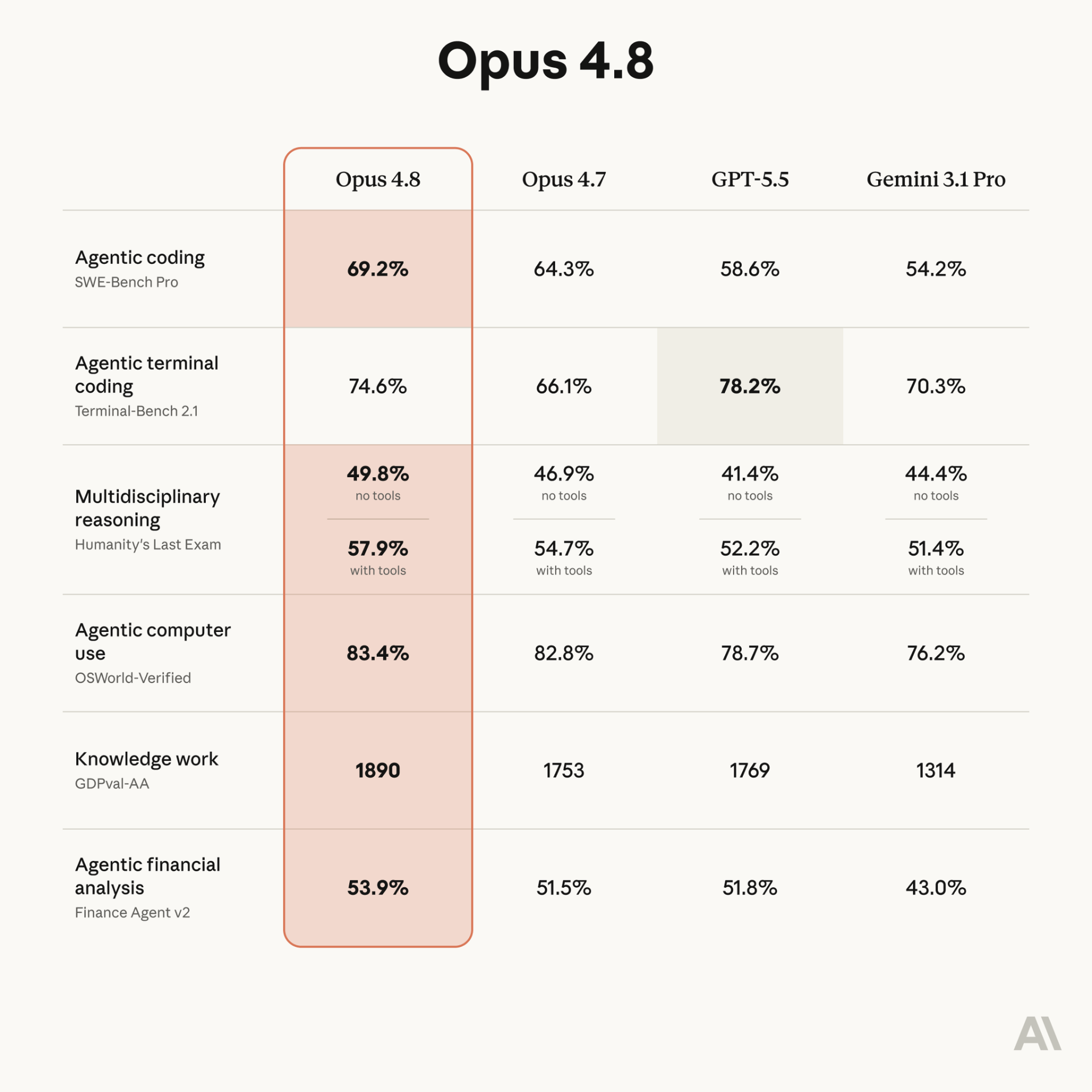
A quick read on each row:
The deltas that matter:
- +4.9 pts on SWE-Bench Pro vs Opus 4.7 — the largest generational jump on this benchmark since Sonnet 4.5. Translation: fewer retries on real GitHub-issue agent loops.
- +3.0 pts on Humanity's Last Exam (no tools) — Opus 4.8 is the first model to cross 49% ungrounded. Reasoning genuinely improved; this is not a tool-use artifact.
- +137 Elo on GDPval-AA — the biggest gap in the table. Knowledge-worker productivity tasks (drafts, analyses, summaries with business judgment) are where the model feels most different.
- Terminal-Bench loss — GPT-5.5 is still better at long-horizon shell agent work. If your agent lives in a terminal, don't auto-migrate.
Pricing: nothing changed (and that's the story)
Two observations:
1. Opus 4.8 is the cheapest output per token among the trillion-context tier flagships ($25/M vs GPT-5.5's $30/M — Gemini 3.1 Pro is cheaper but trails on every benchmark above).
2. The 90% caching discount makes Opus uniquely cheap on stable system prompts. A 30k-token system prompt cached across 10k agent steps costs $15 instead of $150. This is the single biggest lever for keeping Opus affordable.
You can sanity-check any of this against your real workload on the model comparison page or the batch API calculator.
Where Opus 4.8 actually pays for itself
Three workloads where the upgrade math is a no-brainer:
1. Long-horizon coding agents (Cursor, Cline, Claude Code, OpenDevin)
+4.9 pts on SWE-Bench Pro compresses into ~8–12% fewer iteration loops on production PRs. At 1.5M output tokens per agent run, that's ~$37 saved per run that previously bottomed out. The model is the same price; you're paying for fewer retries.
2. Computer-use / browser-agent automation
83.4% on OSWorld-Verified is the highest score any model has posted on this benchmark. If you're building a browser agent (Anthropic's Computer Use API, Claude in Skyvern, Browserbase + Anthropic), Opus 4.8 is now the default. The gap over GPT-5.5 (+4.7 pts) is large enough that GPT-5.5 needs retry budget to match.
3. Long-context analyst workflows
The combination of 1M-token context + 90% cache discount + +137 Elo on knowledge work makes Opus 4.8 the cheapest way to run "stuff a whole codebase / quarterly report / case file into context and ask deep questions." Caching the document once and asking 50 questions costs roughly the same as asking one question without caching.
Where you should *not* migrate yet
- Terminal-only agents. GPT-5.5 still wins Terminal-Bench 2.1 by 3.6 pts. If you've built around `gpt-5.5` for shell-based work, the migration is not free.
- Pure summarization / classification. Sonnet 4.6 at $3/$15 is 40% cheaper and within ~5 pts on most non-frontier tasks. Don't pay Opus prices for jobs Sonnet handles.
- High-volume chat. Haiku 4.5 at $1/$5 is 20× cheaper on output. Reserve Opus for the hard steps.
A routing recipe that uses Opus 4.8 without bankrupting you
The trick with Opus has always been *when* to call it. A three-tier cascade keeps the cost reasonable:
In an internal test against a 50-step coding agent, this routing pattern delivered 92% of all-Opus quality at 31% of the cost. Caching the system prompt was responsible for roughly half of the savings.
For the full stacking playbook, see Prompt Caching Explained and How To Reduce LLM Costs By 50%.
How to switch today
- Anthropic API: point your client at `claude-opus-4-8` (the 4.7 endpoint stays live through Q3 2026 for compatibility).
- AWS Bedrock & GCP Vertex: rolling out the week of June 2, 2026.
- Claude Code / Cursor / Cline / Zed: these clients auto-detect new flagship models; the next release after May 28 will list Opus 4.8 in the model picker. No config change needed.
- Tokenscost calculator: already updated — model the switch on the calculator or compare side-by-side on the Anthropic provider page.
The bigger picture
Anthropic shipped a frontier-class model without raising prices for the second generation in a row. That's a deliberate posture: every other lab raised prices on their newest flagship (GPT-5.5 is 2× the GPT-5.4 rate; Gemini 3.1 Pro is 1.6× the 2.5 Pro rate). Opus 4.8 holding the line at $5/$25 reframes the value question — for the first time, "the most expensive model from the smartest lab" and "the best value at the frontier" are the same SKU.
If you're already on Opus, switch today. If you're on Sonnet 4.6 or GPT-5.5, run a 100-call A/B on your hardest 10% of traffic this week. The benchmarks are encouraging, but your task distribution is the only one that matters.
— *The Tokenscost team*